The Day After

2f47c-ucldh

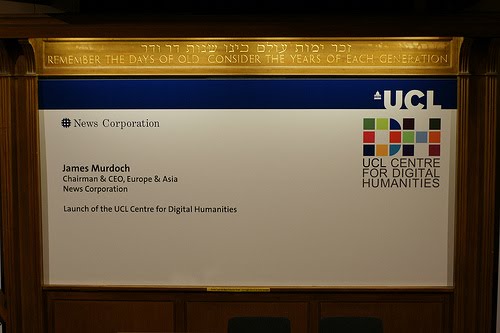
We officially launched the UCL Centre for Digital Humanities yesterday! James Murdoch, Chairman and CEO of News Corporation gave a brilliant speech with strong opinions on creativity, culture, and online content (which you can read the full text of). The Guardian have already covered this – and we are eagerly awaiting responses from cultural and heritage institutions, making the case for freely available digital content as opposed to the paid for model championed by James – as well as considering our thoughts on the matter.

The event went swimmingly – UCL was looking handsome in the early summer sunshine, the champagne flowed, and there were many distinguished guests who we were able to explain the role, focus, and impact of Digital Humanities to. At dinner afterwards, I sat beside the newly appointed Secretary of State for Culture, Olympics, Media and Sport, Jeremy Hunt. It was great to have the opportunity to explain why our field matters, and to showcase the varied research interests we have.

Update: there is quite a lot of media coverage about this.

Gearing up


We’re gearing up to the big launch of the UCL Centre for Digital Humanities here, on Thursday. Expect more coverage soon, including the url on which to watch live streaming action of our opening speaker, James Murdoch from News International, who will be talking about cultural heritage and access in the digital age.

Posters

fb12e-slide18

We are gearing up to the official external launch of the UCL Centre for Digital Humanities. One of the things we have done is prepare a set of 40 or so posters that rather jokily should raise the profile of UCLDH around campus itself. They should be going up on the website in the next week or so, in a rotating gallery, and I’ll share that with you then. I’m really pleased with them – they walk a fine line between provocative and tongue in cheek, and will be ideal for grabbing people’s attention who are, say, going places in lifts at UCL and looking at the posters therein.

Changing the Center of Gravity


Here’s the book cover for Changing the Center of Gravity – the book of essays in memoriam to Ross Scaife that was first published as an online journal volume in DHQ. It’s in press, and should be out shortly.

The British Museum kindly gave us permission to use the image on the front – psychostasia, the weighing of the souls, as featured on a white ground, black figure Lekythos, around 480BC. We thought this a fitting tribute to Ross and a poignant image- not only was he fond of black figure painting from this period, and the scales reference the title of the book, but the weighing of the souls refers to the gods balancing the scales to determine which heroes will not return from battle.

PhD Studentship at UCL in Digital Humanities

We have here up for grabs one PhD studentship to come to the good ship UCL Centre for Digital Humanities to undertake a PhD. Details below.

The PhD studentship in Digital Humanities will be held at the UCL Centre for Digital Humanities which brings together work being done in many different UCL departments and centres, in the humanities, computer science and engineering, as well as Library Services and Museums and Collections. We also collaborate with organisations outside UCL, such as museums, galleries, libraries and archives. We aim to produce research that is meaningful to both computer scientists and humanities scholars, and that will bring about new knowledge in both research areas.

The award may be held by a student working on any topic relevant to digital humanities. However, it should involve genuinely interdisciplinary research, which is likely to require joint supervision from more than one UCL department or faculty. For further information about examples of current UCLDH research projects, please visit http://www.ucl.ac.uk/dh/projects. The award provides funding for tuition fees at the UK/EU rate and a student stipend for three years. Informal enquiries may be made to Samantha Hulston (s.hulston@ucl.ac.uk) or Dr Claire Warwick

Applicants must have at least a good 2.1 in their first degree, and ideally an MA or MSc in a relevant discipline and should have a background in the humanities, computer science, information or museum studies or ideally a combination of some of these fields.

Eligibility

To apply, please download and complete the application form.

More info on the UCL jobs website.