The Ancient World in Silent Cinema

An afternoon & evening of silent film screenings with piano accompaniment and related talks for silent films with settings in Biblical or Near Eastern Antiquity. As with the first screening of films set in ancient Greece & Rome which we held in January, almost all of the films to be screened in June are not available for purchase in video or DVD format, and are rarely shown in cinemas. They survive as viewing copies in film archives. The event is open to the public and admission is free. ALL ARE WELCOME.

Monday 22 June 2009,
at UCL Bloomsbury Theatre, 15 Gordon Street, London, WC1H 0AH

More info here: http://www.ucl.ac.uk/GrandLat/newsandevents/events/silentcinema

(Unfortunately I’ll be in the states. bah.)

back to the future II.

“We can try a little experiment. Let us resort to the fiction of programming an information transducer, a machine to read [ancient] texts. While so far only human beings have learned it, it is equally possible, and may one day be tried, to teach this skill to a machine …”
Erica Reiner (1973) “How We Read Cuneiform Texts.” Journal of Cuneiform Studies 25: 3 -58, p.6.

(and see our project: http://esad.classics.ox.ac.uk/)

Back to the future.

I have a real soft spot for chancing across things written about technological change prior to, say, the 1960s or 1970s. I dont mean things like “we’ll all be living on the moon, wearing reflective suits!” but asides made in academic texts about the state of affairs then, that take on a whole new meaning when you realise the Internet was just around the corner. Take this for example, from Clarke, M. L. (1959), “Classical Education in Britain 1500-1900”, Cambridge University Press, Cambridge, p. 175-6.

We have moved still further from the Ancient World. In literature and the arts we have seen a startling break with tradition, and above all the technological revolution which we are witnessing is transforming our lives and insensibly affecting our outlook, encouraging us to live in the present, judging everything by the standard of technical efficiency and assuming that the latest is always the best. Descartes compared the study of antiquity to foreign travel; it was useful, he said, to know something of the manners of different nations, but when too much time was spent in travelling, men became strangers to their own country ‘and the overcurious in the customs of the past are generally ignorant of those of the present’. Today, there is very little danger of living in the past…

Lovely.

Digital Fail

I experienced my own interesting Digital Fail this week – which probably shows more about my own search habits than faults in Digital Library structure.

I’m just finishing up that chapter for Gabby and Simon, which is about interdisciplinarity and the Digital Classicist. So, as well as talking about disciplines, and learning, and interdisciplinarity, at some stage you have to look at the history of classics as a University discipline.

But could I find much about it on my usual online searches, and searches of online catalogues? Turns out that “classics” is “history” in a lot of catalogues. The searches turned up thousands, if not millions of hits. Noise Noise Noise. Impossible to find the gem I needed in the midst of it*

As I said – probably says more about my own scattergun searching techniques, and I’m pushed for time at the moment. So off I go to the actual library, and ask an actual librarian, and she directs me to an actual room, and I comb the actual shelves, and I find an actual book!

How very retro. And I wonder what else I’ve been missing the last few years that I’ve relied more and more heavily on catalogues and online searches…

* The book I was looking for was “Classical Education in Britain 1500-1900, by M. L. Clarke. (CUP) But I didnt know it was called that when searching for it. Has an interesting 2 page chapter on the “new universities”: such as University College London and Kings College London. And how their teaching will never be up to scratch…

Send Me a Postcard, Drop Me a Line

The (very generous) maternity leave laws in the UK stipulate that you can have ten “keeping in touch” days with your work whilst on leave (which then get tacked on as extra holiday to your period of leave… and the holiday you accrue whilst on leave… did I mention the word generous?) Anyway, I’ve now got to make a note of what I did in my ten “keeping in touch” days for my back to work meeting with my boss next week.

So I thought I’d point you to some of the things of interest:

  1. I chased the book, Digital Images for the Information Professional, through from submission (just before I went off on leave) to publication. Heck, I even designed the cover myself. And no, its not fun to go over the proofs with a fine tooth comb in less than a week when you have an 8 week old baby to look after full time, in case anyone would think it was a good idea.
  2. I edited, alongside Greg Crane of the Perseus Project, a fantastic special issue of Digital Humanities Quarterly called “Changing the Center of Gravity: Transforming Classical Studies Through Cyberinfrastructure” in memory of Ross Scaife. I should have mentioned it before here: a really provocative and strong collection of essays about where digital classicists are going, and what classics will be like in ten years time.
  3. I saw a paper, written with Paul Gooding, through revisions and through to publication: “‘Grand Theft Archive’: a quantitative analysis of the current state of computer game preservation” in The International Journal of Digital Curation.
  4. I took part in the Day in the Life of Digital Humanities blogging experiment.
  5. I got the ball rolling, with Brent Nelson, for a couple of volumes on Digitizing Medieval and Early Modern Material Culture. Hopefully, the contributors should be sending in essays soon – and we are looking for a quick turnaround (ie publication within the next year).
  6. I went to Digital Resources in the Humanities and Arts Conference, for the afternoon, to see a paper about the VERA project.
  7. I answered a tonne of email. As usual.

There were other things not really of relevance outwith my immediate community – Digital Humanities Town Meeting, Computing Science Away Day, visit to the eSAD project at Oxford. Involved in a few grant applications. Wrote a book chapter. Got a couple of papers accepted for conferences. You know, the usual.

The eagle eyed amongst you will probably spot that this probably took up more than ten days of my time. Well, I didnt mind. For a start, it kept my mind ticking over (and I was completely housebound for over 4 months, you have to do something lest you go crazy). And I’m not at all phased about being back at work… my mind has never really been away…

Whistle While You Work!

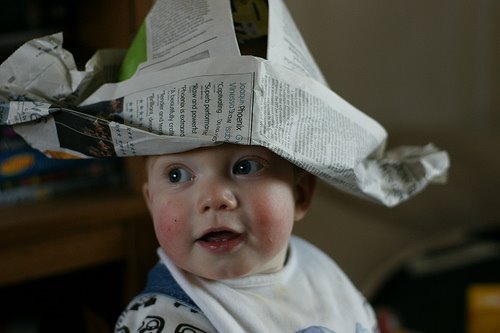
1563e-pirate

So, its back to work for me today, after 10 (!) months of being on Maternity Leave.

Allow me to post one more soppy picture of The Wee Man afore I gets really started.

Over the next few weeks I’ll no doubt post updates and overviews of what I’ve been up to – and what I plan to get up to in the near future. First off, I have an email mountain to tackle (apologies to those who are waiting on a reply for something).

The last year or so has been a strange time – balancing mummy duties with also keeping my head in gear. Those of you who know me will also know I spent most of 2008 in extreme pain, and it took me six months to learn to walk/move again after pregnancy related damage to my spine and pelvis. Life is, thankfully, approximating towards normal – with the small pirate in tow for added hilarity. Phew. Glad that phase is over.

Right. Here I go, wish me luck….