
… my first broadcast from my new shed…
in preparation for the return to work in a few weeks!
… my first broadcast from my new shed…
in preparation for the return to work in a few weeks!
… today is the Day In The Life of Digital Humanities, which is worth breaking radio silence for, as I’m one of the bloggers.
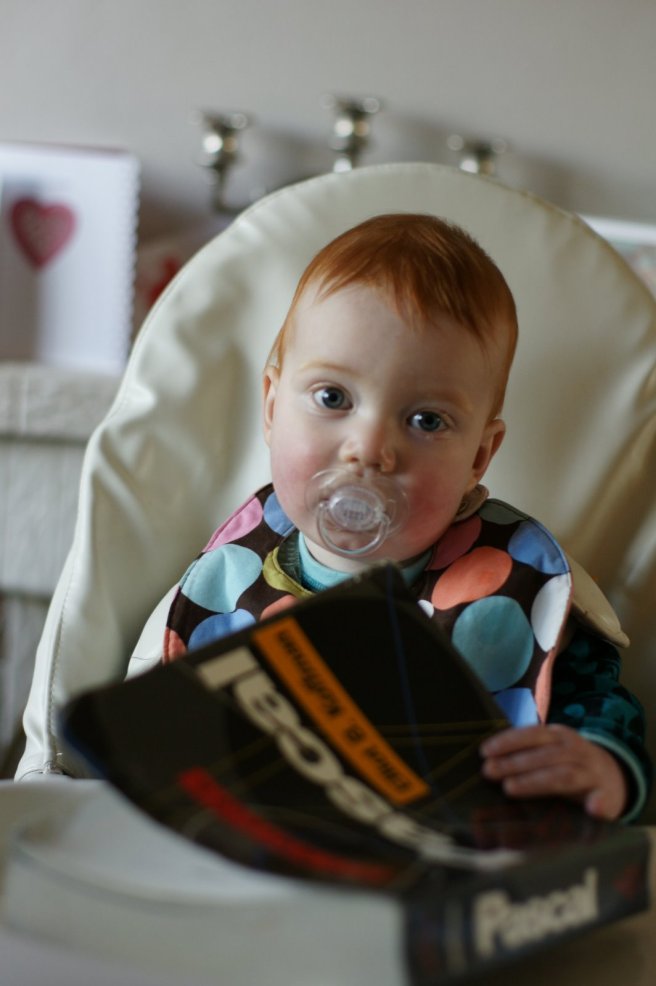
There’s been some discussion of the ethics of posting photos of people, and it was agreed not to post images of children. But here, off-blog, is a picture of he-who-keeps-me-from-work, getting stuck into some elementary coding. Start em young!
Happy New year everyone. Things are going to be slow here for the next couple of months – I’m taking some proper leave whilst I am on leave, and now more mobile, so am going to step away from the machine and get out the house more, before returning to work full time in April. Normal service will resume then!

Festive tidings, everyone. Things have been quiet round here as we’ve been slayed by the various winter viruses doing the rounds. But here he is, in a cheerful santa suit, the likes of which wont be available when the credit is really crunched. Enjoy those pointless dress-up-the-baby-novelty-purchases-and-the-like while you can, and I hope you have a good festive break.
If you’re feeling really cheery, I’ve been involved in doing some fundraising for the baby unit at the Lister Hospital, Stevenage, and if you’re looking for a xmas charidee to give a donation to, then here you go.
Mines is a brandy and babycham, come the drinks order. Merry Xmas!
Sometimes, its fun to do something a little out of your safe bubble in academia. To that end, one of my most recent papers went up today in the International Journal of Digital Curation. Called ‘Grand Theft Archive’: A Quantitative Analysis of the State of Computer Game Preservation, its co-authored with Paul Gooding, who is now the BBC Sports Librarian.
Paul did most of the research, I just helped him polish and polish and buff and polish it into good shape. A fun project for me to be involved in – and an interesting read about the issues regarding preserving our gaming heritage.
Well, I know a good few of you read this blog, so here is another project of mine for further down the line. If any readers are working on relevant research, do get in touch.
Call for Papers: Digitizing Medieval and Early Modern Material Culture
Editors Brent Nelson (University of Saskatchewan) and Melissa Terras
(University College London) invite submissions for a collection of
essays on “Digitizing Medieval and Early Modern Material Culture” to
be published in the New Technologies in Medieval and Renaissance
Studies Series edited by Ray Siemens and William Bowen.
This collection of essays will build on the accomplishments of recent
scholarship on materiality by bringing together innovative research
on the theory and praxis of digitizing material cultures from roughly
500 A.D. to 1700 A.D. Scholars of the medieval and early modern
periods have begun to pay more attention to the material world not
only as a means of cultural experience, but also as a shaping
influence upon culture and society, looking at the world of material
objects as both an area of study and a rich source of evidence for
interpreting the past. Digital media enable new ways of evoking,
representing, recovering, and simulating these materials in
non-traditional, non-textual (or para-textual) ways and present new
possibilities for recuperating and accumulating material from across
vast distances and time, enabling both preservation and comparative
analysis that is otherwise impossible or impractical. Digital
mediation also poses practical and theoretical challenges, both
logistical (such as gaining access to materials) and intellectual
(for example, the relationship between text and object). This volume
of essays will promote the deployment of digital technologies to the
study of material culture by bringing together expertise garnered
from complete and current digital projects, while looking forward to
new possibilities for digital applications; it will both take stock
of the current state of theory and practice and advance new
developments in digitization of material culture. The editors welcome
submissions from all disciplines on any research that addresses the
use of digital means for representing and investigating material
culture as expressed in such diverse areas as:
• travelers’ accounts, navigational charts and cartography
• collections and inventories
• numismatics, antiquarianism and early archaeology
• theatre and staging (props, costumes, stages, theatres)
• the visual arts of drawing, painting, sculpture, print making, and
architecture
• model making
• paper making and book printing, production, and binding
• manuscripts, emblems, and illustrations
• palimpsests and three-dimensional writing
• instruments (magic, alchemical, and scientific)
• arts and crafts
• the anatomical and cultural body
We welcome approaches that are practical and/or theoretical, general
in application or particular and project-based. Submissions should
present fresh advances in methodologies and applications of digital
technologies, including but not limited to:
• XML and databases and computational interpretation
• three-dimensional computer modeling, Second Life and virtual worlds
• virtual research environments
• mapping technology
• image capture, processing, and interpretation
• 3-D laser scanning, synchrotron, or X-ray imaging and analysis
• artificial intelligence, process modeling, and knowledge representation
Papers might address such topics and issues as:
• the value of inter-disciplinarity (as between technical and
humanist experts)
• relationships between image and object; object and text; text and image
• the metadata of material culture
• curatorial and archival practice
• mediating the material object and its textual representations
• imaging and data gathering (databases and textbases)
• the relationship between the abstract and the material text
• haptic, visual, and auditory simulation
• tools and techniques for paleographic analysis
Enquiries and proposals should be sent to brent.nelson[at]usask.ca by
10 January 2009. Complete essays of 5,000-6,000 words in length will
be due on 1 May 2009.
The Europeana website was launched on the 20th November, a large european-wide digital library and archive, featuring digitised items from many major institutions.
And it promptly fell over under the weight of 10 million hits per hour.
The wierd thing about this is that the majority of people were searching for “mona lisa”. (Andy Warhol famously commented, when the Mona Lisa visited New York in the 1960s, that they should have just sent a facsimile. And it seems that nowadays, that’s what the Internet is delivering, and what people want to see).
It seems to reveal something about how people use digital libraries and archives. Woohoo, lots of stuff has been digitised! great! What shall we look up first? Erm….. dunno…. think of something famous that we already probably know….
As part of the LAIRAH research project, we demonstrated that some subjects were the most popular – or most requested – in digitised resources and collections. The Census, witchcraft, suffragettes, shakespeare, chaucer, WWI, WWII… I guess we can now add “Mona Lisa” to that list.
Questions. How many people wont ever come back to this website once it relaunches, given the 404? and really, how exciting is the entry on the Mona Lisa?
There seems to be a raft of new ways to customise bags/wallpaper/think-of-a-flat-surface-you-can-stick-a-digital-image-on with your own pictures at the moment. But the one that really made me go…. “wow” is Spoonflower: print custom designed fabric on demand. Now, let me just get that sewing machine out….
One of the great things about being in academia is the aspect of working from home, as often as you like/can. However, recently my office has just been taken over with all manner of small person’s stuff, cot, etc. Where’s a person to keep her books? …Well, I’m excited to report I’ve just ordered a “home office” to be built at the bottom of the garden, aka “my shed”. In a few weeks I’ll be able to disappear off, and me and the gnomes can hang out in peace… Next up, figuring out how to make our wifi reach all the way down there.

 Professor Melissa Terras MBE FReng