Remembering Paris

I popped over to Paris a few weeks ago to Keynote at “L’image-document face au numérique : mise en crise ou mise en lumière ?” at the Institut national d’histoire de l’art, 5 mars 201. It was great to meet Parisian Digital Humanities folks – and I did my best to follow the papers given by French Art Historians regarding how their work is being changed by computational method.

The organiser of the conference, Elli Doulkaridou, has storified the tweets from the day – capturing the flavour of the discussion.

What was apparent to me was that there was still some reticence in using Digital methods – are they proper methods, and proper research? I tend to forget how far we’ve come in the UK, and how supportive the institution I work in is towards Digital Humanities. Very interesting discussions, and to be reminded that scholars are still fighting to be taken seriously in DH – and I hope to visit again soon…

Blogging In Munich


Greetings from an hotel room in Munich. I cant not blog from here: I was hear to talk about this very blog at Weblogs in den Geisteswissenschaften at Die Bayerische Akademie der Wissenschaften, today.

It was only a 20 minute paper, plus questions, looking at my personal experience of blogging, how this place has developed over time: for example how I used to post “cool stuff what I had found” online here, and now that stuff gets posted to twitter, and this blog is for more reflective content. I talked about the distinction between personal and professional, and where to draw the line at telling people things about your private life, which can be difficult sometimes. I talked about leaving yourself open to snark, and worse, trolls. I talked about developing confidence in this sphere. I talked about how I’ve been putting up little stories about my research, and the type of effect this has had on downloads of papers, etc. I talked about how you balance between the public outreach, and public engagement and actually sitting in front of your computer to get some, ya know, “real work” done. I talked about the reader stats of this little blog (about 100 readers a day now, when I havent posted anything new, and anything around 500 readers a day on the days I have posted something new). All backed up with slides of my previous content posted here. Fun, and some interesting discussions followed about whether we should be encouraging students to do this kind of thing, issues of self confidence in the blogosphere, why there arent more women academic bloggers, and so on and so on.

I then got interviewed for 30 minutes for a documentary for Austrian National Radio on blogging (which I wasn’t expecting) and for something for someone in Switzerland about Digital Humanities (I have no idea what that is even for, apparently they will email me) and then talked to Cornelius Puschmann for an hour about my blog, for his research – on the motivations of academic bloggers.

The whole day was very thought provoking: it has strengthened my belief in why I should bother/continue to keep up posting these random musings here, how beneficial it has been to my career (I met lots of people today who actually read my blog – that is why I was invited here!) and… well, it just allowed me to contextualise what I am up to a bit more, in my own head.

Its been a busy ten days. I should have four or five hours tomorrow in Munich before I have to head back to the airport, so I hope to see an exhibition, as a reward. I didnt even get to tell you about going to Paris on Monday, to keynote there. So in the past 10 days or so, I’ve keynoted in Edinburgh, Paris, and given this talk, as well as been in London for a day 8.30-7pm with meetings back to back, including examining a phd upgrade. Some of that has to wait for another day. Time to recharge, both my computer, and my own batteries. And tomorrow, time to go home. I’m not going anywhere else for three whole weeks!

The Ratio of Physical versus Website Visitors to Museums

I lately joined the Museum Computer Group which has a very active discussion list, and a question was posed lately about how many physical visitors do museums get, versus website traffic these days. @Mia_out helpfully pointed to the UK’s Department for Culture, Media and Sport’s “Sponsored Museums: Performance Indicators 2010-11” which included downloadable spreadsheets of performance indicators like physical and web visitors at http://www.culture.gov.uk/what_we_do/research_and_statistics/8609.aspx.

Here I’ve quickly juxtaposed the total physical visits to museums sponsored by DCMS with their corresponding total web visits (there arent any more nuanced stats, before you ask). Although the ratio varies from museum to museum (check out the V+A! 8 times as many online visitors as physical visitors!) it just gives demonstrable proof of how important web presence is to cultural and heritage organisations.
Have a look (below, I’m having bother with blogger and tables…). Fascinating.

Institution Total Physical Visits 2010-2011 Total Unique Web Visits 2010-2011 Ratio
British Museum 5,869,396 21,496,815 3.662526
Geffrye Museum 104,691 527,082 5.034645
Horniman Museum 584,974 252,867 0.43227
Imperial War Museum 2,317,639 8,587,082 3.705099
Museum of Science and Industry in Manchester 638,347 330,000 0.51696
National Gallery 5,084,929 4,500,000 0.884968
National Maritime Museum 2,450,155 10,052,347 4.102739
National Museums Liverpool 2,635,993 3,176,266 1.20496
National Museum of Science and Industry 4,093,463 15,020,206 3.669315
National Portrait Gallery 1,758,488 13,724,626 7.804788
Natural History Museum 4,812,197 7,397,821 1.537306
Royal Armouries 462,753 403,379 0.871694
Sir John Soane’s Museum 109,604 365,099 3.331074
Tate Gallery 7,450,000 19,427,000 2.607651
Tyne and Wear Museums Service 2,018,233 1,006,250 0.49858
Victoria and Albert Museum 3,049,000 24,976,400 8.191669
Wallace Collection 357,538 305,609 0.854759
Total Visits 43,797,400 131,548,849 3.003577

On Academic Juvenelia

The real life tomb of Sennedjem at Deir el Medineh, juxtaposed with my VRML model of the tomb
The real life tomb of Sennedjem at Deir el Medineh, juxtaposed with my VRML model of the tomb, made back in 1998.You can probably guess which is which?

So, to my final set of paper publications, in my tour of things that I have published, which have been put into UCL’s Open Access Repository. This is going back, way back, to my MSc dissertation, in 1998. I was undertaking an MSc in IT in the Department of Computing Science, at the University of Glasgow, and worked for the summer on a dissertation supervised by Dr Seamus Ross (now Prof at Toronto), in the Humanities Advanced Technology and Information Institute. The dissertation subject matter was chosen by the Kelvingrove Art Gallery and Museum, who have various artefacts from the tomb of Sennedjem – could a VR model be built to show more about where they were originally found? They were working with a multimedia company to try and put computing in the gallery space – could I build something for them?

I used the top notch tech du jour, VRML 2.0, to hand script the whole thing, including complex geometry, fly throughs, animated creaky doors and tomb stones, based on published archaeological evidence about the complete tomb complex (not just the room above, which is the famous bit). I remember 3 months of working alone in a lab from 10am til 10pm, up to 7 days a week, so immersed in programming slow, clunky VR that when I got up from the chair to interact with the real world it moved too fast, and I got covered in bruises from walking into walls and doors and chairs. I remember working late into the night and hanging out in internet chat rooms for company. I remember this is when I started to put on weight (its not a dissertation unless you get “the graduate gut”, right?). I remember regularly partying at Glasgow School of Art – the cliche of work hard, play hard. I remember doing user testing where people just wanted to drop shoot-em-up avatars into the virtual archaeological complex and said “is that it?” when you showed them the VR model. Yes, thats it. That’s all a VR model does. Lets you explore it. I remember the multimedia company employed by the museum being a little bit “meh”and then asking me for all the code which they wanted to own copyright on (it wasnt as if I was being paid for this, you understand). It never made it into the museum, that I know of. I’m not sure that multimedia company actually built anything that went into the museum. But still! I completed the model which really is testament to what online virtual reality could achieve in 1998. How wonderful it looked then. How blocky it looks now!

Throughout this whole summer (it was the best of times! it was the worst of times!) Seamus was a fantastic supervisor who really spurred me on and encouraged and cajoled me to produce something that in the end was worthy of a distinction. I was proud of it then, I’m still proud of it now. I still aspire to be as helpful and constructive and thoughtful and understanding to my MA and PhD students now as he was to me then. I’ve said it before, and I will probably say it again – do we ever leave our academic supervisors?

I had thought at the end of the process to Never Ever Do Anything Academic Again, and had vague hand-wavy plans to “go travelling” or stick around Glasgow and take the bands I was in then a little more seriously. In the final weeks of my dissertation, Seamus thrust an application form into my hands to do a PhD at Oxford on some tablets from this Roman fort called Vindolanda.

On the last day of my dissertation – which was due in at midday, Seamus called into the lab, and said “How would you like to give a paper about your dissertation?” “Sure,” I said “when?”. “2pm.” said Seamus. “There’s a conference on here and someone is sick and has pulled out of their slot.” So I bound up my dissertation, handed it in, wrote a powerpoint version, trotted home and put on a suit, and gambolled down the hill to the place where Digital Resources in the Humanities 1998 was being held, and gave my first academic paper. I was a little too honest. I hadnt seen an academic paper before. I then was allowed to take home any food that was left from the buffet lunch – I was on my uppers after a year of self-funded study. Someone stopped me when I was filling my bag with apples, to ask what was I doing – that person was Edward Vanhoutte. And a more-than-a-decade long friendship in Humanities Computing (as was then) was forged.

And here are the papers that emerged from it. The Internet Archaeology paper came about because Seamus suggested I wrote it up, and put me in touch with the journal editors: I wouldnt have done it without this encouragement. I wouldnt have given it the title it has now (you learn, I suppose, how people would find academic papers, and I dont think that this title sums up what it’s about, now).

Terras, M (1999) A Virtual Tomb for Kelvingrove: Virtual Reality, Archaeology and Education. Internet Archaeology (7) PDF

And then there’s the one paper from my whole back catalogue that I cant find in digital form. The one that got away. It’s only 1000 words, so I could type it in again (why? the Internet Archaeology one is better). There is one last hope – somewhere in the eaves of my house is my old laptop from back then, that may have a copy of this on it. One day I will get round to digging it out, but til then, it lives to show that my digital-born archival strategy wasnt quite as good as I wanted it to be (isn’t that always the way?):

Terras, M (1999) The Sen-nedjem Project: Archaeology, Virtual Reality and Education. Archaeological Computing Newsletter , 53 4 – 10.

And here endeth my tour of academic papers that I have published. Next up, the verdict: is it worth putting papers up in Open Access?

Update: since posting this, the wonderful Jeremy Huggett at the University of Glasgow has emailed me the .tex file that they have in the archive for ACN, so I now have a version in text of the lost file! will reformat and post to the repository soon… which means my paper archive is complete! Thanks Jeremy! Complete Set!!!!!11111!!!!!1111111!

When Cloud Services Die

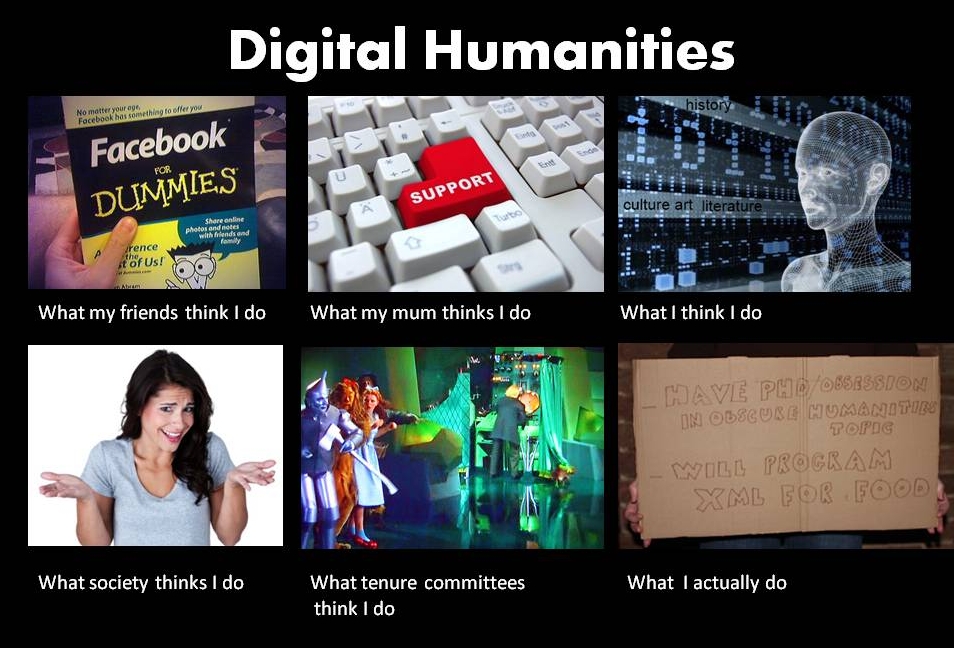
1a43e-whatdhdoes

For the past few years I’ve used Brizzly to look at my tweetstream when on my desktop. It has some great features, but dont bother investigating them, as from the end of the month it will be going. The team got bought out by AOL and are now doing other things. Bah. I have to learn new habits. I hate learning new habits.

Along with it will go some of the content that I posted on the twitters. We all know cloud services are ephemeral, right? Right? Well, here’s the proof. The “what DH thinks it/actually does” meme that I stuck up a mere 3 weeks ago using Brizzly (why? cant quite remember, it was late on a Sunday night and it seemed the quickest way to do it), which garnered hundreds of RTs, and was viewed here alone 1927 times (and elsewhere on facebook and blogs and google+) will go with it. Of course there are versions of it elsewhere. But the Brizzly address that was shared far and wide was the one the dead links will point to.

Darn. Rookie mistake. Oh well. Like the interwebz sayz, that meme jumped the shark, forever ago. And if you pay nothing…

Day of Ideas, Edinburgh University

Hullo from Edinburgh. I’ve quite liderally just given my opening keynote at Digital Scholarship: A Day of Ideas which is a day of

talks and discussions for staff and PhD students in HSS (Humanities and Social Sciences), to inspire and share ideas for digital research, teaching and scholarship. An exciting programme of invited speakers working in the field of digital scholarship will present their ideas and their work.

It is taking place at The Business School at the University of Edinburgh. Full programme is available here. The event is part of the Digital HSS programme of activities at Edinburgh.

I should be listening to the next speaker, but it will take me 10 minutes to come back from the place that I go to when I give the big public lectures. It is quite the out-of-body experience. (Whee! Free Drugs!)

I didnt have the time to write out my lecture long hand to post here. I did consider it – but I’m giving three big talks in the next couple of weeks (after Edinburgh there is Paris and Munich) plus another two guest lectures here tomorrow (since I’m here!) so… sorry, email and regular work (like writing lectures for my students in London!) inbetween lecture writing took precedence. But, fear not – there are livebloggers on the case! Nicola Osborne has pretty much covered what I talked about – almost scared to read through it myself – but here it is.

And now, to refocus on Ethnography as Play by Dr TL Taylor, currently happening as I blog this.

On the hidden opportunity costs of maternity leave in academia

I’ve been back to work 6 months since the end of my maternity leave. I’m up to full speed, resumed normal duties including teaching, even taken on more than I had previously. In general, its all great. I’ve followed with interest the many discussions that have been taking place about the effect of having babies on academic careers, and how much leeway someone should have for, example, submitting things to the REF if they have had a period of maternity leave, but mostly I find I’m in a good place. I publish, I have published, I will publish. I have ongoing and new research projects. I have plans (oh boy, do I have plans) and I hit the ground running when I came back to work. And on top of that, academic flexible working hours! Days working from home! Plenty of time to see the boys! Academic motherhood FTW!

But something has come up once or twice lately which has made me think about the impact of maternity leave, and having babies, on an academic career, which I thought it worth mentioning and adding to the discussion.

Academia is a long-term game. The conversation you have in passing with a colleague in the corridor may end up in being a joint funding bid a year later, with actual funding a year after that, and research outputs – the stuff we’re all judged on, such as papers, conference papers, etc – emerging one, two, or three years down the line. What happens if someone becomes pregnant in that time? What is the opportunity cost – the thing foregone – if you are part of a research team, and a research project?

For me, opportunity costs started weeks after I became pregnant. Because it was my second pregnancy, and because it was twins (twins!!!! surprise!!!!), it was obvious to the world what was happening before I was even ready to tell colleagues. I made it clear that because it was a high-risk pregnancy, even though I was pregnant with twins didnt mean I would actually have twins. But still, the word was out. I was dropped from research projects, funding bids, project meetings without even being consulted. I can see the logic in this: she’s going to be away on leave when this project is happening! But the fact of the matter is, that should have been my decision, and although I probably would have come to the same conclusion myself, if I had had the chance to react, I should have been asked. It is thoughtless and rude, at best, and actually illegal under UK and EU law to exclude someone because of pregnancy. Never mind, I thought, suck it up. The opportunity cost of pregnancy- all being well – is that you wont be included on things, wont be present to take part in things, because you’ll be on leave with your child. It was my choice to have another pregnancy. But I didnt foresee the hidden opportunity cost: it’s not just the time you are on leave, but for the months – in my case 5 months – before that others will decide you should not be included, consulted, kept in the loop.

What has made me think of this now? Because, after all, my employer was very supportive of a difficult, high risk pregnancy, that thankfully had a happy outcome. Well, in the last wee while I’ve had various different things fly in on email for me to have a look at and comment on, before it was submitted to conferences, or journals, etc. Things emanating from projects that I was heavily involved in, and continue to be heavily involved in, and plan to be heavily involved in – but I was on leave for a year (technically, 9 months) while the project was ongoing. It doesnt matter that I bust a gut to keep on top of email when I was on leave, and contribute where I could to ongoing projects, even in cases dialing into meetings, or commenting on drafts of papers, etc. My name isnt anywhere on the research outputs, the things upon which I will be judged. I’ve even had to ask, in some cases, to be included in a footnote, when I was central to the project becoming established.

This is the real hidden opportunity cost of maternity leave in academia. Its not the 9 months you take off on leave, its the months before where people exclude you, and the months after where people say “She was on leave for that period. She doesn’t get to be an author on this”. My 9 months of maternity leave has actually meant a two year CV hiatus, for some projects I was – am! – involved in. (The flip-side, of course, is that on some projects, I’ve been included on everything, by very kind and supportive colleagues. But should I have been?)

I should say that this isnt a passive agressive post. I’ve said loud and clear to colleagues “Hey, I noticed I wasnt on the author list for this, and thats ok, I was on leave. But from now on, given I’m part of the team, I want to be kept up to date with the project, and included on outputs”. I’m a confident adult and perfectly capable of speaking up. I know it’s difficult, and that most colleagues have done their best to navigate the fact that I was on leave, even though it may have sometimes meant more work for them. I understand that I wasnt around for a while, and I accept that. But its been six months since I came back from leave, and I feel I am actively contributing to various ongoing projects. When will the hidden opportunity costs of maternity leave in academia stop?

Reflections on a doctorate

Stylus tablet 836, one of the most complete stylus tablets unearthed at Vindolanda. The incisions on the surface can be seen to be complex, whilst the woodgrain, surface discoloration, warping, and cracking of the physical object demonstrate the difficulty papyrologists have in reading such texts.

Only two research projects left to talk about in my survey of what I have done previously, and this is the biggy, the blast-from-the-past upon which your star will forever be hung, the doctorate. I cant even say PhD – you get a DPhil from Oxford, which will confuse people evermore.

My doctoral funding came from an EPSRC grant, working on an established, funded, project at the University of Oxford, which was split between The Department of Engineering Science and the Centre for the Study of Ancient Documents, as a collaborative project between Professor Mike Brady, and Professor Alan Bowman. They were interested to see if they could use new and novel imaging techniques to try and read the damaged inscriptions on the Vindolanda stylus texts, above. At the start of 1999 I joined them on a 3 year project, where two doctoral students and a postdoc were employed. My role was to work in the space between the classicists and the engineers, given I had a training both in classics (but classical art!) and in computing science.

I’m not going to kid that this wasnt hard work, nor a tough time for me – but looking back, I see its part of the doctoral process that you generally get the stuffing knocked out of you, and then you rebuild yourself and are academically stronger as a result. Essentially, I hadnt done an undergraduate in Engineering, or Maths – but was being examined in Engineering. It was a steep learning curve, and I had a lot of catching up to do, learning a lot both about Latin and Probability Theory, Roman Archaeology and Parallel Computing. I successfully defended in January 2003 – although it took me months to even face doing the (2 hours worth) of corrections, and a further year to go back to the work and turn it into Image to Interpretation, my monograph published by OUP.

I published five pieces on my doctorate, as well as the book. One of them is pretty promissory (in general, something that has the words “Towards” in the title, you think, aye aye…..)

Terras, M (2000) Towards a reading of the Vindolanda Stylus Tablets: Engineers and the Papyrologist. Human IT , 4 (2/3) PDF.

Although the further three pieces are more substantive, the last one contains the maths:

Terras, M. and Robertson, P. (2004) Downs and Acrosses: Textual Markup on a Stroke Based Level. Literary and Linguistic Computing , 19 (3 ) pp.397 – 414 . PDF

Terras, M. (2005) Reading the Readers: Modelling Complex Humanities Processes to Build Cognitive Systems. Literary and Linguistic Computing , 20 (1 ) pp.41 – 59 . PDF

Terras, M and Roberston, P (2005) Image and Interpretation: Using Artificial Intelligence to Read Ancient Roman Texts. HumanIT , 7 (3) PDF.

The final paper is a contribution to an edited volume we were all asked to write a paper for, to reflect what research was being undertaken in our department at UCL, so it has crossovers with these two, above (and there is probably room, at some point, to discuss just how much you can publish in a paper that has already been covered elsewhere, in a different format, for a different audience, as its a pretty murky academic practice):

Terras, M (2006) Interpreting the image: using advanced computational techniques to read the Vindolanda texts. ASLIB Proceedings , 58 (1/2) 102 – 117. PDF.

It’s only in the most recent couple of years that I’ve started to focus again on imaging of manuscript material, and how best we can tackle degraded texts. I’m working again with computer scientists and engineers on some fairly gnarly imaging problems, and its very rewarding – although the fun, now, is knowing I wont be examined at the end of it, and I dont have the “what will become of me!” stress that people have to face at the end of their doctorate (even though I am committed to helping my PhD students over those mental hurdles). It’s now almost (six months short of) a decade since I handed in my PhD. How did that happen?????