What happens when you tweet an Open Access Paper

8a66b-stats

So a few weeks ago, I tweeted and posted about this paper:

Terras, M (2009) “Digital Curiosities: Resource Creation Via Amateur Digitisation”. Literary and Linguistic Computing, 25 (4) 425 – 438. Available in PDF.

I thought it worth revisiting the results of this. Is it worth me digging out the full text, running the gamut with the UCL repository, and trying to spend the time putting my previous research online? Is Open Access a gamble that pays – and if so, in what way?

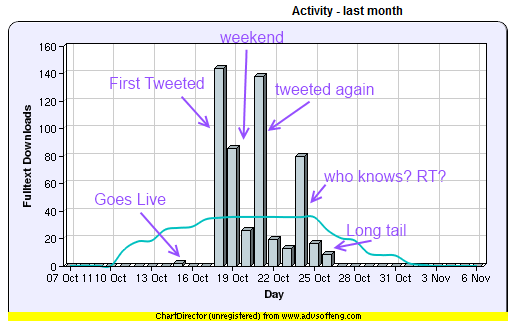
Prior to me blogging and tweeting about the paper, it got downloaded twice (not by me). The day I tweeted and blogged it, it immediately got 140 downloads. This was on a friday: on the saturday and sunday it got downloaded, but by fewer people – on monday it was retweeted and it got a further 140 or so downloads. I have no idea what happened on the 24th October – someone must have linked to it? Posted it on a blog? Then there were a further 80 downloads. Then the traditional long tail, then it all goes quiet.

All in all, its been downloaded 535 times since it went live, from all over the world: USA (163), UK (107), Germany (14), Australia (10), Canada (10), and the long tail of beyond: Belgium, France, Ireland Netherlands, Japan, Spain, Greece, Italy, South Africa, Mexico, Switzerland, Finland, Denmark, Norway, Sweden, Portugal, Europe, UAE, “unknown”.

Worth it, then? Well there are a few things to say about this.

  • I have no idea how many times it is read, accessed, downloaded in the journal itself. So seeing this – 500 reads in a week! makes me think, wow: people are reading something I have written!
  • It must be all relative, surely. Is 500 full downloads good? Who can tell? All I can say is that it puts it into the top 10 – maybe top 5 – papers downloaded from the UCL repository last month (I wont know until someone updates the webpage with last months stats).
  • If I tell you that the most accessed item from our department ever in the UCL repository, which was put in there five years ago, has had 1000 full text downloads, then 500 downloads in a week aint too shabby. They didnt blog or tweet it, its just sitting there.
  • There is a close correlation to when I tweet the paper and downloads.
  • There can be a compulsion to start to pay attention to stats. Man, it gets addictive. But is this where we want to be headed: academia as X-factor? Hmmm.

Ergo, if you want people to read your papers, make them open access, and let the community know (via blogs, twitter, etc) where to get them. Not rocket science. But worth spending time doing. Just dont develop a stats habit.

I’ll feature the next one from my back catalogue, shortly…

Update 08/11/11: As a result of posting this, and this post getting retweeted far and wide (thanks all!) the paper got downloaded a further 120 times. See? See?

Update 08/11/11: The UCL stats page for downloads last month has now been updated: this was the 5th most downloaded paper in the UCL repository in October 2011. Yeah, I’m up there with fat tax, seaworthiness, preventative nutrition, and the peri-urban(?) interface. I’m not sure how many papers in total there are in the repository – I cant find that stat – but a search for “the” or “a” both brings back 224,575 papers, if that is anything to go by.

Update 10/11/11: The Digital Curation Manager at UCL, Martin Moyle, has been in touch to confirm that 6486 of the 224, 575 papers in the repository have downloadable full text attached. And told me where I can generate this stat. Whoops! (Thanks Martin).

Update 10/11/11: After this post, there is the predictable long tail happening with stats. Another 60 downloads on the 8th, 10 on the 9th. Its all quite predictable – yet nice that the paper is wending its way to interested parties!

Update 25/11/11: This post was mentioned in the Times Higher last week, and the paper has now been downladed 805 times in total.

Full Steam Ahead

The people at UCL Discovery are now talking to me, and things are moving forward. I have lots of things ready to go and in the pipeline – which gives me, I reckon, at least one thing to talk about a week on here for the next academic year. I’m also feeding back usability issues to them (like, NO, dont delete the conference paper just because I published a paper in a journal with the same title! YES thats me in that record, even though my name isn’t capitalised. NO, Melody Terras who works in Social Sciences at the University of the West of Scotland IS NOT ME).

You can tell I’m delighted by this whole state of affairs, huh?

Seriously, the whole process of sorting out my publication record on the institutional servers/ system is turning out to be a massive timesink. Previously, I had just been keeping a note myself of what I had been up to on my old webpage. That has to go, and I have to generate everything from their database. Which is taking me hours to deal with. Progress!

But, as someone once passive aggressively said to me, “lets move on”. Lets talk about what I’ve been up to – and also, what I’m going to be up to in future. And let’s talk about what happens when you tweet something…

On thumb twiddling

Well. I bet you are wondering what has happened to my experiment in Open Access Publishing, where I am putting papers up online in our institutional repository, and sharing the best tales behind the papers here.

If it has stalled, its certainly not my fault. Finding drafts of things is much easier, so far, than I had imagined – I’m the messiest person in real life, but turns out I’m pretty organised, informationally. No. The slowness comes from – shall we call it a pipeline?

I’m currently waiting on over ten papers to go “live” in our institutional repository, since I have uploaded them. I’ve been waiting on them to go live for a month. I have no idea how the process works. I submit papers: I wait. I get no email to indicate progress. Sometimes the person (and it is a person, they make a note on the record) deletes the file, with no reason given. I upload it again. It gets deleted. I send emails. They are ignored. I send more emails. They get replies from an email address that doesnt give the person’s name, just the “institutional repository”. I reply to those emails. They are ignored.

And so it goes. Lessons in black-box service provision, if ever there was one. Absolutely infuriating. I can see how people give up on uploading things to institutional repositories. I simply dont have the time to hassle them into providing the service they are supposed to. I am not asking them to do anything difficult, after all: just to mount a file. Italics here means: grrrr.

But I shall plug on. I’ve started complaining further up the tree – hopefully it will trickle down and eventually I shall have something to show for all my hard work – which they say they want to show off. Hmmmm.

I didnt count on the institutional repository itself to be a barrier in making my work available through open access. It means I have actually stopped submitting things. What’s the point? I have 100+ more papers to put up there. Why should I waste the time in submitting things if they are ignored?

I also made the decision to blog once about each research project, and tweet the remainder of papers that come out. The LAIRAH project, for example, which I blogged about below, also featured others papers that are freely available for download on the institutional repository. I’ll list these at the end of this post: they made it through the barrier previously.

But for the more interesting stuff – and what tales I have to tell you! – you’ll have to wait til someone (and it is a someone, not an anonymous pipeline, repository, or computer – how we hide behind these terms!) presses the button to make more stuff live. And stops deleting things willy nilly. Sigh.

Warwick, C., Galina, I., Rimmer, J., Terras, M., Blandford, A., Gow, J., and Buchanan, G. (2009). “Documentation and the users of digital resources in the humanities“. Journal of Documentation. Volume:65, Issue: 1, Page: 33 – 57.

Warwick, C., Terras, M., Galina, I., Huntington, P., Pappa, N. (2008). “Library and Information Resources, and Users of Digital Resources in the Humanities”. Program: Electronic Library and Information Systems. Volume 42 Number 1. p. 5-27.

Warwick,C. Galina, I., Terras, M., Huntington, P., and Pappa, N. (2008). “The Master Builders: LAIRAH research on good practice in the construction of digital humanities projects” Literary and Linguistic Computing 23(3), 383-396.


Update: within 24 hours of throwing my rattles out the pram, things are moving, and we have action. Am pleased to say that finally we are making progress. I’ll be able to start posting things again on here next week, as a result. Hurrah!

Sleep Deprivation + Deadlines = Wacky Paper

Sometimes, its things happening in your real life that determine your academic direction.

Like most undergraduates academics I occasionally drop the “and this requires further work!” line into a conclusion of a book chapter or paper. I try and store these in a pop-stack in my brain for when I need a quick research output. When writing a chapter on digitisation for Digital Images, I made an aside about people beyond institutional boundaries who were carrying out systematic digitisation projects. This, I said, requires further work!

A year later, I’m on maternity leave with my firstborn. Late pregnancy and maternity leave is incredibly isolating and lonely. I, personally, looked forward to resuming my academic life, and making adult conversation. Wouldn’t it be great, I thought, to go to a conference soon after my return to work, and see everyone in the flesh? Wouldn’t it be great to pitch up at Digital Humanities 2009?

But. To get funding to go to a conference, I needed to have a paper accepted. To have a paper accepted I needed to do some new research, and write an abstract. I had nothing new, and no time to do anything new. My brain was also quite, quite fried from dealing with the sleep deprivation that accompanies a newborn. A plan was hatched during 3am and 4am and 5am feeds to put in a rather promissory abstract (tut tut, they are supposed to report on something you’ve already done) on a small research project on “amateur” digitisation projects. If accepted, it would have the added benefit of giving me a little two-week research project to do as soon I got back to work, to kick start my brain. If it wasnt accepted, it could go back in the “requires further work!” pile. I could not gauge if this was a good idea, or not. It was an idea, and that is all that mattered.

Usually it would take me an afternoon to bash out a conference abstract. This took a painful four weeks of trying to get my head in the zone between baby mewling and nappy changing.

The abstract was accepted. I went back to work, and did the study. I went to Maryland, I gave a paper, I caught up with colleagues, I had a fabulous time. I was then asked to write up the paper for the conference proceedings (something I hadn’t planned on doing). What the hey! So here it is:

Terras, M (2009) “Digital Curiosities: Resource Creation Via Amateur Digitisation”. Literary and Linguistic Computing, 25 (4) 425 – 438. Available in PDF.

Its a bit wackier than my normal stuff. Its very positive – I chose to look at the “best” of amateur digitisation, rather than the worst. It comes from a place of sleep deprivation and left-of-centre. And it’s one of my most cited papers. (The book I spent 6 years on? Not so much…)

From the archive: the LAIRAH study

I’m currently trawling through my research papers and submitting them to UCL Discovery to make them publicly available. It is taking more time than I had imagined: not to find the original texts, but for them to go through the system and go live. I’ll talk more about this soon as I have a better idea of the issues behind putting research outputs online, but the first paper I want to report on (mainly as its one of the first to make it through the goalposts) is:

Warwick,C. Terras, M., Huntington, P., and Pappa, N. (2008). “If You Build It Will They Come? The LAIRAH Study: Quantifying the Use of Online Resources in the Arts and Humanities through Statistical Analysis of User Log Data”. Literary and Linguistic Computing.23(1), 85-102. Available in PDF.

This is one of the papers that emanated from the LAIRAH project: Log Analysis of Internet Resource in the Arts and Humanities. This was an AHRC funded project that ran from July 2005 to September 2006.

How quaint, I hear you say. Log Analysis! Why would you bother to do that? Wouldn’t you just use Google Analytics? Now, of course, you would, but when we submitted the grant application, Google Analytics was just a idea called Urchin on Demand, and it didnt come on stream until the end of the project. We wanted to provide some robust measurements of how people were using digital resources, and what this meant for those creating resources for the humanities. As far as we knew at the time, we were the first to look at server logs in this way, for this domain. Or at least, the first to plan to look at server logs.

There were several issues in actually getting hold of server logs – turned out people didnt want to hand them over. I would have liked to get more into the nitty gritty of what exactly people were doing, but we had limited access, and access to portal data rather than individual websites.

The resulting paper draws some interesting conclusions, particularly our quantitative findings “that users from academic domains tended to be more persistent and use different search strategies to reach their goals” and the importance of nomenclature, documentation, and provenance in creating useful digital resources in the humanities. I like to think that this project began to address the fact that we have to understand user needs when creating digitised content, at a time when people were merrily digitising and creating websites without much understanding of how or why they would be used.

Nowadays, of course, you’d use Google Analytics to monitor how your digital project was used. But projects are still not keen to share access statistics with the wider community…

Open Access, UCL, and Me

In the past couple of years, UCL has really been pushing the open access agenda in academia. Announced in 2009, the open access policy states

That, copyright permissions allowing, a copy of all research outputs should be deposited in the UCL repository in Open Access

and UCL is aggressively pursuing what is often called “Green OA”, where research from subscription based journals is made publicly available in an online repository that hosts the final accepted versions of a writer’s output.

UCL staff have been asked to manage their publications, and much of UCL’s research output is now parked up at UCL Discovery, where full text of publications emanating from UCL academics can be found. There has been a fair amount of press coverage about this, and UCL is often mentioned as the trailblazer in Open Access when it comes up in discussion.

However, the archive is only as good as its holdings, and the holdings are only there if academics dig them out. For the past couple of years I’ve had it vaguely on the to do list to trawl through my personal archive to locate the last-but-one version of published material, and mount on UCL Discovery. Now is the time to do it, as I have also got to port over and manage all my websites, databases, and research records on systems that have changed in the year I’ve been away. Its a half-an-hour-a-day-for-three-months kind of tinker.

And I thought – why, wont you join me on this tour? When things go live, I’ll post a little thing here about the research, how it came about, what the outcomes were, and link to the full text of the papers themselves. As I go further and further back, it’s also going to be a test of my personal archiving strategy…

An example to get the ball rolling? My plenary at Digital Humanities 2010 “Present, Not Voting: Digital Humanities in the Panopticon” was originally posted on this blog, but I was asked to write it up for the conference proceedings, which appeared in Literary and Linguistic Computing, 26 (3). Discovery has a nice summary page which gives the abstract, etc, and the PDF of the full text is available from there.

The plenary got a fair amount of coverage at the time, so I wont talk too much about this one. I hope to post one or two “new” papers a week up here over the next few months, and will tell the story behind each one as I do.

Reviewing the Blog Situation

One of the things I wondered in my last post before I started maternity leave was – what would the status of the blogosphere be when I got back to work, a year later.

Unsurprisingly, it’s still here.

I’ve been thinking if there is a place for this blog, and how things have changed over the past few years. There’s no doubt that a lot of the things I used to do here – post links to good online resources, make short comments – have been trumphed by twitter, and I’ll continue to hang out over there. But I still have use for a place where I post, every now and then, something more than 140 characters. I’ve had comments in the past that some regular readers (or at least, regular before I took a hiatus) like to know what its like to be an academic, so I’ll continue to post on what I’m up to. I’ll park the text of plenary lectures and invited speeches here (they are quite a lot of intellectual work, and its good to be able to share them to a wider audience). Its also on my to do list to sort out my UCL web presence – more on that soon – so whilst I was doing that I thought I would chat on here about the work I’ve done previously, as I need to trawl through my personal archive over the next couple of months to get things ship-shape.

I’m not too keen to share too much personal information beyond my academic role (hey, that’s for facebook, right?) and I was reminded of this with a review of my blog, posted online last year. It contains the genius line that made me smile

It’s tough to evaluate Melissa Terras’ Blog; I can’t make fun of it, because I don’t understand most of what she posts

but also liberally lifts my picture, and that of my newborn twins from here. You live by the sword, etc…. but it was a (non-threatening) reality check for me. At the moment, I dont have the personal need to address too much about non-work stuff up here, so I wont. I had me some babies. Everyone is doing fine, thanks. I am now back to work.

All this to say – normal service is resumed! and perhaps shall be even more organised on here than previously.

Removing Tumbleweed

Well. I’ve been officially “back to work” for a couple of weeks, so its time to think about dusting off this blog, and putting it to good use. Until now I’ve been mainly fighting fires, and trying valiantly to climb the email mountain that has accrued in my year long leave. Its time to start being proactive, rather than just reactive though – once I get to the bottom of that email pile, that is.

I’ve popped into college a couple of times (I am on sabbatical for a term to get my feet back under the table before I take on full teaching and admin duties). It’s probably worth me describing just how much has changed in the year I have been at home: our department moved buildings, so I have a new office, which I am having the pleasure of making feel like home, a year after everyone else did. (Given I was so disabled, our departmental administrator organised my old office to be packed up and shipped over, so I am merrily going through boxes now, going “I own that?”) Its taken me a few days to get back on the network, locate cabling, etc. I still have no idea where lots of things are in the new department, and it will probably take a long time to know where to get X, Y, and Z. In addition, my old Head of Department left UCL with little warning, taking with him some colleagues. New appointments have been made, new faces, new routines. We also have just started the new MA in Digital Humanities, so there is a whole new course to sort out (although Simon Mahony is doing a stellar job of being Acting Course Director at the moment, until I get my act together). All change! In these respects, it is almost like going back to a new job – but with some very familiar faces and places thrown in too.

Research wise, I’m at an interesting juncture: the main projects I was working on before going on leave have all wrapped up, so I’m coming back to a phase of grant writing, and book proposal writing, and bootstrapping research again. I have plenty to read, plenty to catch up on – and plenty to write, too.

I’m also in the very, very final stages of putting together, with Brent Nelson, “Digitizing Medieval and Early Modern Material Culture” (New Technologies in Renaissance Studies. Toronto: Iter; Tempe, AZ: Arizona Centre for Medieval and Renaissance Studies.) We are at the final proofs stage – fingers crossed we can press the button on this shortly. Next up? Editing “Digital Humanities in Practice” – due in to Facet very soon.

I’m itching to *make* something, though. Itching to code, create, make computers do something, instead of just talking about computers doing something. Plans are hatching for my next research direction, and future research proposals – I want to rejoin the ranks of Digital Humanists who implement computational tools. Its been a while, but I have been on leave for a year.

In which time email has piled up. Best get back to it.

Peering Inside the Big Tent: Digital Humanities and the Crisis of Inclusion


(This is an overview of what I hope – or plan – to say for my plenary talk at Interface 2011, 27th July 2011, UCL London. I’m not a fan of reading from the script, so may deviate, hesitate, repeat, and elide on the day. I am told a video will follow, if you’d rather…)

I’m delighted to be here at Interface 2011, and to be partaking – and mixing – with the Digital Humanities community. The title of my talk refers to a few things. Firstly, I’ve not actually done any Digital Humanities for over a year: I’ve been peering at DH from afar, due to being at home doing voluntary work with my own circus troupe (aka “maternity leave”). It is amazing, though, how much you can glean from the twitters, blogs, and email lists whilst up all hours with the bairns, so whilst I have not been hands on, I’ve been closely following the doings and goings on of those who have actively been Digital Humanitiesing.

Secondly, “The Big Tent” was – of course – the theme of DH 2011, which I was unable to attend and am frankly jealous of anyone who did. I was peering at it from afar, and this issue of “Big Tent Digital Humanities” seems to have galvanised discussion in the field about the changing nature of the discipline. I thought is a useful perspective, and definition, to explore (without criticising anyone who organised DH2011).

And finally, “Peering inside the big tent” alludes to the fact that Interface is primarily a conference for graduate students working between the fields of humanities and technology: so many, if not all, of those attending, although still backstage at the moment, aim to be performing front of house in an employed position in the academic circus sooner rather than later. I hope what I say is, then, of use to those nearing the end of graduate studies in DH.

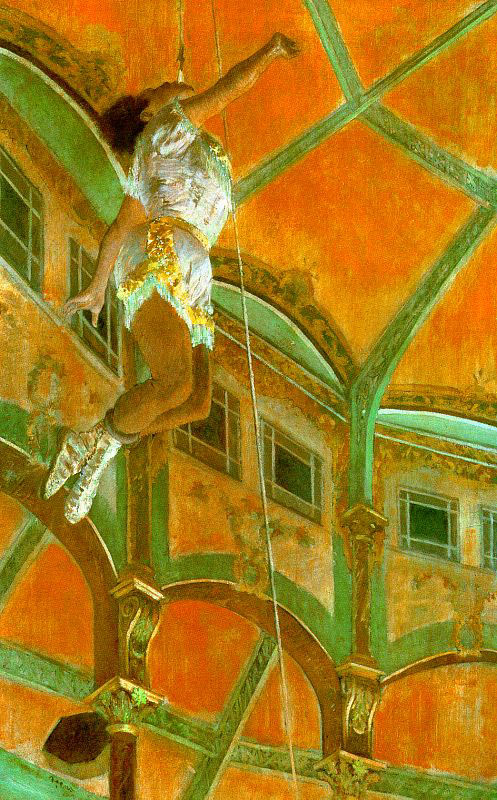
But I want to start with something decidedly non digital. Pre-digital, even. I studied Art History in my undergraduate days, and was thinking of what a career in the humanities meant to students, then. It started with the slide test, where we learnt and memorised hundreds of paintings, and were expected to be able to mobilise knowledge about them expertly. (Note – In the lecture I undertake a slide test here of Degas’ Miss La La at the Cirque Fernando, 1879, National Gallery, London). We would study 35mm slides, cramped round a slide cabinet perhaps 5 students deep, for hours, and back this up through print publications and gallery visits. If you caught the bug, you might do your undergraduate dissertation on, say, Degas and his circus paintings. You may then do a MA dissertation on the Impressionists and their circus paintings. If you were good enough, and fortunate to gain funding, you might do your PhD dissertation on the use of perspective in Degas’ circus paintings, and what this “means” for modern art. Eventually, after stiff competition, you may get a post teaching modern (used in the broadest sense) art, and your research would become highly specialised in perspective in impressionist paintings of performance. After years of hard graft you’d own this area, and write in this area, and have found and read every book and article on this area, and publish the elusive monograph in this area. You may have even travelled widely to see every painting in this area in the flesh, not to mention visiting many archives and libraries. It would take years to even piece together all the information you needed to become an expert in the field.

Let’s contrast that to today’s information environment. You are not sure of the exact painting you are interested in, and rather than remember it, a quick google of “degas circus painting” leads you to the Wikipedia page of Miss La La. You can find a link to it at the National Gallery, London, where you can zoom in in so much more detail that you could ever see in a 35mm slide, or even up close when visiting the gallery. You can see where this fits in to the pantheon of Degas’ – and the Impressionists’ – oeuvre by looking up the complete works of all Impressionist paintings, online. The complete works of Edgar Degas shows you every single known study for Miss La La, and you can see high definition images of a pastel study for the painting on the Tate website. You can look up historical newspaper archives to see if there was anything written about the painting or artist in the past, find relevant journal articles that refer to the painting from the comfort of your own laptop, and see if it had been mentioned particularly in any book published since the painting was painted. You could even wander up to the painting virtually using the Google Art Project (well, you will be able to once the NG expand their coverage of Google Art beyond the couple of galleries that have been digitised via street view technology). You can see other’s views and visits of the artwork by a simple Flickr search (which is something art historians love, in particular, for looking at alternative views of sculptures held in museums, beyond the official viewpoint in the print catalogues). If you are in the Gallery, and want more information about a painting, you can simply take a picture on your phone, and search Google with that image, or use Google goggles to tell you more about it. (I am aware that I am mentioning Google frequently: a) I am “not-working” from home and therefore unable to easily access other institutional resources, and b) they do provide an easy suite of tools to use in the first instance, even if there are shortcomings and limitations). You can do a reverse image search using Tin Eye to see who else is talking about that image/ artwork. If you have the access, and resources, you could use advanced imaging techniques to study both the creation and the current condition of the artwork, for conservation purposes and beyond. You could use computational methods to analyse the angles and perspectives of the human figure in Degas’ artworks. You could virtually recreate the Cirque Fernando in 3D to investigate the artist’s perspective of Miss La La. If you didn’t know how to do any of this, you could ask twitter for some pointers, and within minutes someone in the DH community would have responded. Post a question on DH answers, and within 24 hours you would have the best advice on how to study perspective in modern art, using computational methods.

What part of this is Digital Humanities? Is it the act of googling the painting? Using the zoom on the NG website? Using the complete works of Edgard Degas, Google Art Project, JStor, Flickr or even Wikipedia? Is DH the creation of the online resources? The digitisation of books and journals? Is DH the use of tools to study how the painting was created? Composed? Curated? Is DH the study of the use of these tools by users to study art? Is DH the development of techniques and algorithms to analyse the painting? Is DH the means to ask the wider community advice? Is DH the infrastructure which allows the advice to be detailed and delivered to even more scholars? Is DH the use of electronic images of art in powerpoint slides discussing DH? And who is the Digital Humanist? The creator of digital resources? The writer of algorithms? The user of programs? The person who analyses the action of the user? And should academia take any of this seriously?

What is Digital Humanities? And what is Digital Humanities for? To paraphrase Larkin, Ah, solving that question brings the doctors of philosophy in their long coats running over the fields. There is a lot written about this (it’s not the place here to give a history of the definition of DH, but emergent scholars could do worse than make themselves familiar with a lot of the arguments). It’s something to do with the Humanities, and digital technologies, but what exactly, we are slow – and even reluctant – to pinpoint. The latest definition, “Big Tent Digital Humanities”, deliberately obfuscates the focus of the field. Roll up roll up! Everything is Digital Humanities! Everyone is a digital humanist!

The concept of a “big tent” to demarcate a group of individuals is a pragmatic and flexible description usually used to give strength in numbers, permitting a broad spectrum of views or approaches across the constituency. The term has been around for a long time, actually originating from religious American groups in the 19th century (see also “broad church”) rather than the circus background the name implies. It is most commonly applied to political coalitions that have a wide spread of backgrounds, approaches, and beliefs. In some respect it is well suited to Digital Humanities – what are the “Humanities” if not a “big tent” of scholars interested in the human condition and human society? What are the “Digital Humanities” if not a broad spectrum of academic approaches, loosely bound together with a shared interest in technology and humanistic research, in all its guises?

In many regards, “Big Tent Digital Humanities” is a nice concept. It is true that the DH community is considerably more open, approachable, welcoming, and willing to embrace new approaches than many traditional areas of humanities academia. Big Tent DH, then, is an ecumenical approach, whilst giving the freedom for individual scholars to explore their own interests, wherever in the research and teaching spectrum they lie. And why would anyone want to limit the constituency of DH? Surely as technology becomes more and more pervasive in society, finding humanities scholars who do not use any aspect of digital technology in their research will become rarer. As recent blog postings have discussed, anyone who has the interest to do so can tinker with DH, and DH is one of the easiest disciplines to go DIY in. Big Tent DH provides a shared core of likeminded scholars who are exploring digital frontiers to undertake work in the humanities, and welcomes those interested in engaging and learning further about the application of potentially transformative technologies.

But. Just as political parties who are too “big tent” can be criticised for adopting populist policies without any clear remit, stance, or goal, “Big Tent Digital Humanities” has its issues when you look at the detail. It is all very well saying that DH is open and welcoming and encourages participation – but despite open platforms such as DH answers, and the DIY approach, it is still a very rich, very western academic field with a limited number of job openings for the growing number of humanities PhDs that are being produced that have some digital element to them. Let’s be honest: most people undertaking graduate research who want to continue doing research when their studies are finished would like to be paid for it and make it their livelihood, rather than go the DIY, in your own time after the day job, route. I don’t want to dwell on the numbers of PhDs that go onto have academic posts – as far as I’m concerned PhD students should have done their homework on that before undertaking a PhD, and there have always been limited openings. It’s probably true that DH, at the moment, still has more career openings than other, singular humanities subjects. We also have an increasingly popular “#alt-ac” trajectory, where individuals can go on to rewarding alternative academic careers that are not tenure track (what is the alternatives to #alt-ac? #ten-trac-ac? ) However, despite all this, there will be a lot of folk left peering into the Big Tent, without ever gaining full access of any paid employment in DH. Institutional support means access to computational infrastructure, journals, money for equipment, conference travel, paid sabbaticals to write up research, payment which enables you to subscribe to journals and scholarly societies, etc. We should be careful with our descriptions of how open DH actually is, and the resources required to participate in DH research and development, for those without institutional backing. Personally, I don’t like the associations that come with the “Big Tent” label: it paints DH as a transitory spectacle with all the connotations that come with the circus. Branding is important, and (given the experience we in DH have had in trying to be taken seriously by our traditional humanities colleagues) suggesting the field is best described using a big top metaphor, although it may be a bit of fun, is worrying. You don’t see many string theorists describing themselves as “Big Tent Particle Physicists!” – we should be careful what view of ourselves we are projecting into the wider academic world. Our acceptance, even our current fashionable status, has been hard won: and what goes up must come down. Is there really no better way to describe the strengths and objectives of our community?

In lots of ways, though, getting hung up about the term “Big Tent Digital Humanities” is a red herring. Like London buses, there will be another theory – or three – about Digital Humanities along in a minute. However, it is an acceptance that the field is changing, and growing. And therein lies the “crisis” in my title. The field can only continue to expand, as more and more people engage with the technology that allows them to undertake academic tasks, and who are we to ring fence the academic field that lets people discuss this and learn more? Who are we to limit participation in the field to those with paid full time jobs? But if everyone is a Digital Humanist, then no-one is really a Digital Humanist. The field does not exist if it is all pervasive, too widely spread, or ill defined.

As DH expands we run into issues chasing funding (there will always be limited resources, which are now competed for by larger and larger groups of scholars). But perhaps the sticking point that we all most keenly feel, when applied to our own research, is the effect the expansion of DH has on peer review – the essential sifting mechanism around which a discipline functions. There were many vocal complaints on twitter about reviews for papers submitted to DH2011. In some cases, including papers that I was co-author on, the returned reviews varied from high score to dismally low scores – with the comments from the low scorers making it clear that the reviewers did not have the foggiest what the research was about. There is no mechanism to appeal this – and one low score can mean a paper is rejected. The acceptance onto conference programs can spell the difference between attending and not attending conferences, or being published or not being published, and so, in the longer term, career progression. The problem of the Big Tent, or the Broad Church, is that the experience and knowledge of individuals is so loosely bound that “peers” can often have little real insight into the relevance of applicability of a given specific research topic (which, by its nature, should be specialised). As the community around the DH conference expands, this will become an ongoing problem. If everyone is DH, if the field is all encompassing, how can we trust the peer reviews (good or bad) that come from within the community? Does “Big Tent Digital Humanities” mean that DH peer review is broken?

I think there are other, more useful things to concentrate on when defining DH than the “Big Tent” idea. Going back to the pre-digital versus digital scenario given at the start of the lecture: I believe DH has been poor in articulating the changes the digital information environment and its related tools have wrought to humanities scholarship, and the changes and potential that this means for individual scholars. The roles and positions I find myself filling are not those I would have associated with a singular academic career in the pre-digital environment, nor does the publishing avenues of our research chime with the traditional views of the academy (although what did I know then of how academia worked?). Partaking in DH and building a career around its framework means that I have enjoyed researching in many fields: classics, archaeology, history, archival studies, computer gaming, high performance computing, image processing… but unlike the scholars of “old” (all of 15 years ago) I’m very aware I do not own a specialised field, or have a specific research remit, or have the will, means or opportunities to churn out the monographs. DH has allowed me to be jack of all trades, master of none – is this what the Big Tent really means? It is something I have occasionally struggled with, as it would be nice to lay claim to a research area and become noted for work in that area alone. Many digital outputs will never be found on library shelves. Many of the senior scholars in DH, though, have “portfolio” research careers, keeping up to date with developments in technology and applying them variously in different disciplines in ways that would not make tenure in the pre-digital world. Behind the scenes at the Big Tent there are people building interesting, diverse skillsets, and it would be useful at some stage to acknowledge the changing academic role and remit as personified by DH scholars, as well as saying “we’re all DH now”.

The irony is, of course, that the way for young scholars to gain full entry to the Big Tent (whether in #alt-ac or tenure track posts) is still through the specialised focus of PhD research. (Although there are plenty of established scholars in DH without doctorates, even the most perfunctory of positions now usually dictates that applicants hold a PhD in a relevant area). Like an individual circus performer, the individual scholar must become the expert in their chosen, niche area, and hone their own skill and approach. However, if there is one piece of advice I can give to those embarking on an academic career, it is to look around the Big Tent, and to see what skills are most needed, asked for, and employable, and to make sure that these are also part of your skillset. For example, I have no research interest in textual encoding and markup, but I make sure that I follow the gist of what is going on with the technology, and would be able to teach it. XML and TEI are such a core part of any DH teaching program that it would be remiss not to have experience in this area. Make sure you know the basics of Internet Technologies, Databases, and even GIS. Experiment with programming, at least just to see what it is about. You may not believe it at the moment, but Graduate students have the luxury of time to pick up and learn new skills beyond your immediate research. Use whatever training courses your institutions offers wisely, while you have the opportunity. Once you hit employed life, the time and opportunity to develop your skills in such a wide manner becomes severely rationed.

Make sure you are visible in Social Media circles (show that you are actively peering in, before applying for positions). Engage with others doing different DH research: use the Big Tent as a way to network with people, whilst seeing what new technologies are being appropriated within DH. Make sure you make yourself ready for employment: a cursory glance at employment adverts for DH will show that those with job openings are asking for a lot. I wonder if the spread of topics and skills demonstrated in the Big Tent constituency mean we are almost asking too much from individual applicants at the very start of their careers: you want to join the circus? Show us you know how it all works!

My second piece of advice would be – read “Alternative Academic Careers for Humanities Scholars” (edited by Bethany Nowviskie). Understand the arena you want to be employed in, and the various approaches there can be there to getting jobs there.

My final piece of advice is – learn to touch type. If you are planning to be a professional Digital Humanist, there is a whole lot of silicon-face time to be spent. Invest in your future by learning how to engage with the digital in the fastest and most efficient way possible (at the moment).

And then I should probably all wish you good luck out there, but I’m going to end with the painting of Miss La La at the Cirque Fernando. It’s the analysis of such objet, and the potential for digital techniques and technologies to aid us in understanding different perspectives of the human condition that drives Digital Humanities. But it is also about tenacity, and application, and hard work, and expertise. There’s not much “luck” in the skill demonstrated by Miss La La in this painting: its sheer, hard won, strength and agility. Despite all the “Roll up! Roll up!” talk and advertising, the wonder comes down to whether or not she can actually apply herself, and undertake the task. It’s the same for Digital Humanists: despite the changing definitions and perspectives that surround our field, the value and usefulness of our skills are demonstrated through what we actually do, the research we undertake, the tools we build, the people we teach, the literature we write.

I am looking forward to actually doing Digital Humanities again. It is in the doing that we can explore what the changing information environment means for the Humanities, and scholars in the Humanities. We can argue the limits and boundaries of our constituency, and the list of essential skills that make up DH, over and over. But as digital technologies become increasingly pervasive, the work and skills of Digital Humanists become increasingly important. We are holding on tight to our place in academia – by our teeth, if needs be.

In which I tentatively start to think about work, again

You know you’ve been away from your blog too long when a colleague emails you to say “so when were you thinking of updating it…?” I did say I would resurface in the Spring, but here we are mid Summer…. and here we are, above. Everyone is doing well, I’m back to full mobility, and life is settling into a chaotic but rewarding routine. I’m not back to work proper for another two months, but in walks around the Common with the buggy I’m starting to ruminate on what’s next, what I want to research, etc. There are plenty plans up my sleeve.

It’s not like I’ve been idle, either – I have been hanging out aplenty on twitter (@melissaterras) as the micro blog form seems to suit the 5 minutes here or there of peace I have whilst running after the three youngsters. There are also various other things that have been going on, which I will detail properly when coming back to work.

On Wednesday – I am actually leaving the house, to go into that there London, to the Interface Conference, where I will be one of the plenary speakers. Nothing like a baptism of fire when getting back into work things after a year away from the office, I find. I’m looking forward to seeing real people (I hope you look like your avatars). If you are there, say hi.

I’ll post my plenary text here after the event. And be back to work, properly, in mid September. Looking forward to it.