
Interesting discussion going on over at the Guardian blog, regarding whether
the brave new world of digital literature has been largely anti-climatic.
Worth checking out the comments.
Interesting discussion going on over at the Guardian blog, regarding whether
the brave new world of digital literature has been largely anti-climatic.
Worth checking out the comments.
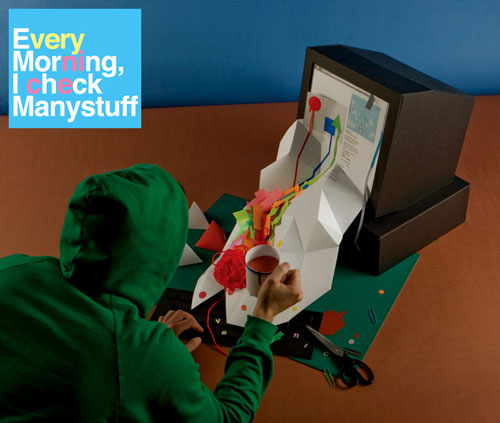
We all have our set of “essential” websites we have to check first thing in the morning. Depending what mood I’m in, I’ll have a sneaky peek at fffound, or http://www.booooooom.com/, (or etsy, if I’m in the mood for shopping), to see what the “creatives” are up to these days. I was particularly taken by this work by Nicolas Burrows. Sums up how I’ve started the day for the past 15? years…
… from the film “You, Me, and Everyone We Know”
Housewares Saleswoman: I think everything’s gonna be computerized in twenty years.
Sylvie: Soup won’t be computerized.
Housewares Saleswoman: Why not?
Sylvie (exasperated): It’s a liquid!
The new advert for the Nintendo Wii on youtube is genius. Keep watching…
 In the Spring, we invested in a decent Digital SLR. Ironically, I was too busy to get to grips with it, given I was working all hours (on top of the day job) to finish the book on Digital Images before the arrival of The Wee Man. Now, I’m enjoying having the time – and a captive subject to play with – to experiment with it a little.
Photography and children go hand in hand. Susan Sontag said
Cameras go with family life. Not to take pictures of one’s children, particularly when they are small, is a sign of parental indifference… Those ghostly traces, photography, supply the presence of dispersed relatives. A family’s photograph album is generally about the extended family (Sontag 1979, On Photography, p. 8-9).
A child born today will probably have more photographs taken of them in the first year than a child born 50 years ago would have had in their lifetime, given the affordances of point-and-click digital cameras. The silent problem, though, is that folks are so lackadaisical in their approach to long term maintenance of personal digital image collections, that most of these digital images will not be around in 50 years time. Discuss.
“Official” photography of babies is still big business, even in the digital era. In the UK, a few hours after giving birth, you are accosted by the “Bounty Lady”, sponsored by the government and industry, to provide you with all the forms you need to register the birth, sign up for child support benefit, and get your hands on child trust fund money. In return for all your details, you also get a bag full of samples of pampers and fairy liquid and the enviromentally-unsound like (and research shows that folk tend to stick with the brands they are presented with when their baby is first born. Kerching!). Then the Bounty Lady sticks a Digital camera in your baby’s face (oooh, fancy), and for the bargain price of only £30 or so you can have a Digital print of your wee lamb. At least, I think that was the cost of the smallest package – I was still out of it, having been awake for 3 days by that point.
We smiled smugly and pointed out our range of digital cameras and camcorders which we had with us, and neglected to pay the inflated fee for the snapshot. (You’ll have to be my friend on facebook to see such video classics as “Thumper throws shapes” and “Rhythm is a Dancing Baby”.) Every single other new mother on the ward stumped up for the costly point and click snap.
In a few weeks, the Bounty Lady (or other commercial equivalent) is turning up to mother and baby group, again, to take a snapshot of all the babies, and charge inflated prices for photo-printed tat just in time for xmas. I’m tempted to take along the DSLR and practice my photography skills with other folk’s kids for free. Then they can trot down to the interweb and get whatever they want printed up themselves at normal prices. But maybe that’s not the way to win any new friends (or get a free pack of environmentally-unsound pampers). Just say cheese like everyone else…
“Away with him, away with him! he speaks Latin!”
-Shakespeare, Henry V Part II.
… I’ve added the newfangled Blogger tool, “Following”, so folk can say whether they read this blog… not sure I’ll keep it up there yet. If no-one signs up, I guess I’ll take it down. If too many people sign up that it gives me the fear, maybe I’ll take it down…. 🙂
I really should just enable google analytics on this blog and have done (although I dont know why, given that google owns blogger, that they cant let you switch on analytics automatically without grubbing around in the source code yourself).

I just watched a fascinating documentary called “The Mona Lisa Curse”, by the art critic Robert Hughes. A very personal polemic about how the financial markets now own – and ruin – what we call “art”, by treating it as a commodity and ignoring the underlying artistic statements, comments, and visions inherent in the work. Art is stripped down to a series of icons which now change hands again and again for exorbitant sums of money. (You can still watch this online for a few days, if you have a spare hour its worth taking a look, if just to see all the footage of the NYC art world in the 60s, and Hughes’ telling off of the modern collectors who have no idea about what art is, beyond its financial value).
What has this got to do with digital humanities? Hughes traces the phenomenon of art as commodity to a world tour made by the Mona Lisa in the 1960s. I quote from the documentary
over a million americans filed past it… I had this premonition…. it managed to turn the mona lisa into a kind of 15th century television set….
in 1963, in new york, the mona lisa was now treated like a photo in a magazine, to be quickly scanned and then discarded. When Andy Warhol heard that the painting was coming to new york, he quipped “why dont they just have someone copy it and send the copy? no-one would know the difference”. The work I had once so admired conjured up a nightmarish vision of the future of art. With swarms of passive art imbibers lining up to be processed by therapeutic culture shots. This glimpse into the future saw something quite real: the orgy of consumption that would tear open the art scene…
The documentary is about finances, and how money has ruined the art world. It didnt touch on modern media, really. But I wonder about this idea of reproduction and facsimile, about image and reproduction. How is digitisation any different? Is it a good thing to divorce the fetishisation of the material object from the “icon” it represents? We are now merrily creating and disseminating Warhol’s copies of masterpieces (and apprenticeship-pieces) via imaging and network technologies. How are these used? what evidence is there that this furthers research and study? Are we just feeding Hughes’ “passive art imbibers” via new media?
… is now online, here. Which should save you the £90.25 it currently is going for on Amazon for a physical copy! Well worth a read through to get an overview of how computers have been used to aid in the study and analysis of literature over the past 40? odd years.
…. the book just went to press. Calloo! Callay!
 Professor Melissa Terras MBE FReng